
MOON BAG RUFFLE


SUPPLY CHAIN
A backpack or bag is made up of many materials, components, and ingredients manufactured and supplied by numerous partners. Here we would like to introduce our main suppliers (T1) and the steps of our products, as well as the entire supply chain of our primary material RE:PET.
Please explore the map to understand these parts of our supply chain.
Warehouse


Recycler


Production partner


Clean-Up


Headquarter


Yayasan GOT BAG Indonesia Foundation Office, in Yogyakarta, Indonesia
Koordination und Durchführung des Clean-up-Programms
Our partner foundation Yayasan GOT BAG Indonesia runs a clean-up program that collects plastic waste. In addition, the foundation focuses on education and expanding the waste management system to comprehensively address the problem of ocean plastic pollution. We are in regular contact with the eight full-time employees of GOT BAG Indonesia. Our Lead of Mission Leonie visits the organization multiple times a year to work closely with the Indonesian team and the collecting communities. She reviews progress and makes decisions together with the team about additional projects.

Clean-up Communities, in Bantul, Indonesia
Plastikmüllsammlung
The clean-up program was launched in Demak on the north coast of Java. This Indonesian region is located at the mouth of several rivers that transport large amounts of plastic waste from the island's mainland into the sea. GOT BAG Indonesia has since expanded its program to the regions of Jepara in the north and Bantul on the south coast. The clean-up program includes fishers and other collectors who gather plastic from the sea, mangrove areas, and coastal regions such as river delta areas. At the collection points, residents who do not have access to functioning waste management systems can also dispose of their household plastic waste. Additionally, we source plastic bottles for the production of our backpacks from our recycling partner's plastic collection network, which is Ocean Bound Plastic certified.

Clean-up Communities, in Demak, Indonesia
Plastikmüllsammlung
The clean-up program began in Demak on the north coast of Java. This Indonesian region is located at the mouth of several rivers that transport large amounts of plastic waste from the island's mainland into the sea. GOT BAG Indonesia has since expanded its program to the regions of Jepara in the north and Bantul on the south coast. The clean-up program includes fishers and other collectors who gather plastic from the sea, mangrove areas, and coastal regions such as river delta areas. At the collection points, locals who do not have a functioning waste management system can also dispose of their household plastic waste. Additionally, we rely on our recycling partner's plastic collection network, which is Ocean Bound Plastic certified.

Clean-up Communities, in Jepara, Indonesia
Plastikmüllsammlung
The clean-up program began in Demak on the north coast of Java. This Indonesian region is located at the mouth of several rivers that transport large amounts of plastic waste from the island's mainland into the sea. GOT BAG Indonesia has since expanded its program to the regions of Jepara in the north and Bantul on the south coast. The clean-up program includes fishers and other collectors who gather plastic from the sea, mangrove areas, and coastal regions such as river delta areas. At the collection points, locals who do not have a functioning waste management system can also dispose of their household plastic waste. Additionally, we rely on our recycling partner's plastic collection network, which is Ocean Bound Plastic certified.

Warehouse in Jepara, Indonesia
Sortierung, Reinigung, Ballenpressung und Lagerung von Plastikmüll
All recyclable plastic types (e.g. PET, PP, HDPE, LDPE) collected and submitted by community collectors are brought to the foundation's warehouse in Bantul or Jepara. There, staff manually sort the material by specific plastic types and colors, removing labels and caps. The sorted and processed plastic is then compressed into cube-shaped bales by a machine. These are then transported to corresponding partners in the region for mechanical recycling.

Warehouse in Bantul, Indonesia
Sortierung, Reinigung, Ballenpressung und Lagerung von Plastikmüll
All recyclable plastic types (e.g. PET, PP, HDPE, LDPE) collected and submitted by community collectors are brought to the foundation's warehouse in Bantul or Jepara. There, staff manually sort the material by specific plastic types and colors, removing labels and caps. The sorted and processed plastic is then compressed into cube-shaped bales by a machine. These are then transported to corresponding partners in the region for mechanical recycling.
PET Recycling Partner Surabaya, on Java, Indonesia
PET-Recycling für die Produktion des RE:PET-Materials
PET bottles collected and processed by GOT BAG Indonesia's collection communities are sent to our recycling partner in Surabaya. Here the material is shredded, washed again, dried, melted, filtered, and extruded into rPET pellets. In addition to the PET bottles collected by the clean-up program, we also source Ocean Bound Plastic certified PET through our recycling partner on Java.
Certifications: Ocean Bound Plastic, Global Recycled Standard

RE:PC Recycler, on Java, Indonesia
Quelle für recyceltes Polycarbonat
RE:PC is recycled polycarbonate material made from discarded water dispenser containers. These containers are not collected through GOT BAG Indonesia's clean-up program, as a replacement system typically exists for them. We therefore source these materials from our recycling partner in Indonesia, who collects the containers within a maximum radius of 50 km from the coast from restaurants or businesses that use water dispenser stations. The recycled polycarbonate we use for our RE:PC is Ocean Bound Plastic certified and a very lightweight and durable material, ideally suited for luggage cases and sunglasses.
Certifications: Ocean Bound Plastic, Global Recycled Standard
RE:NYNET® Recycler, in Taiwan
Quelle für recyceltes Nylon
RE:NYNET® is a recycled nylon fabric made from discarded fishing nets. We source this material through our partner and yarn spinner Formosa Chemicals & Fibre Corporation in Taiwan. We use RE:NYNET® for products that benefit from its soft, lightweight yet durable properties.
Certifications: SGS, ISO 45001:2018, ISO 14001:2015, ISO 9001:2015, Global Recycled Standard, bluesign System Partner
Recycling Partner, on Java, Indonesia
Mechanisches Recycling von Kunststoffen (ausgenommen PET)
For some plastic types that we cannot use for products ourselves, such as PP, HDPE, LDPE, etc., the GOT BAG Indonesia foundation continuously expands its network with locally based companies that can mechanically recycle them. They are processed into so-called secondary raw materials before they can be used for other products.

Cement Plant, on Java, Indonesia
Partner für die Verbrennung von nicht-recycelbarem Plastikmüll zur Energiegewinnung
A large portion of the plastic waste collected by GOT BAG Indonesia consists of non-recyclable composite materials. Many plastic pieces are also too heavily degraded by sun and saltwater to be mechanically recycled. Many plastic materials therefore do not have sufficient quality or can only be recycled with disproportionately high effort. We currently pass these materials on for thermal recovery, where they are used as an alternative to fossil fuels for energy generation.
Yarn Spinning Mill, near Taipei, Taiwan
Garnproduktion für RE:PET
At our partner's spinning mill, we produce so-called filament yarn from the rPET pellets. The base yarn is 300 denier, meaning a 9,000-meter-long thread weighs 300 grams. The yarn is extruded in an almost endless process from the molten PET. After extrusion, the yarn is stretched to be strong enough for subsequent weaving. For black fabrics, we dye the yarn during extrusion — this dyeing process requires neither water nor solvents. Additionally, the spin-dyed yarn has an extremely high color fastness.
Certifications: Ocean Bound Plastic, Global Recycled Standard
Weaving Mill, near Taipei, Taiwan
Weben, Färben und Beschichten des RE:PET- und RE:NYNET-Materials
The yarn is woven in a weaving mill into a particularly robust 600D or a lighter 300D Oxford fabric. The best yarn qualities (AA) are selected for the warp yarn, as the tensile strength requirements are highest with dense weaving. All black products are typically spin-dyed. This means that black color pigments are added to the yarn during spinning, eliminating the usual wet-dyeing process. For all non-black products, we dye the textile directly after weaving with disperse dyes in a nearby dyeing facility. We avoid dyes and additives that appear on a negative list (e.g. from Oeko-Tex, Bluesign, or ZDHC). After dyeing, the fabrics are coated on the back with a thin TPU layer of approximately 0.15 mm — for waterproof welding. On the outer side of the fabric, a very thin, permanently water-repellent PU coating is applied.
All fabrics for sewn products receive only a thin waterproof PU layer on the back and a PFC-free DWR coating on the outside.
Certifications: ISO 45001:2018, ISO 14001:2015, ISO 9001:2015, Global Recycled Standard, bluesign System Partner
Cut, Make, Trim in Jepara, Indonesia
Zuschnitt und Schweißen von RE:PET-Produkten
For our waterproof products, we use the high-frequency welding process. In high-frequency welding, materials are first cut and then welded together using specially made molds in the high-frequency machines. The TPU material is melted at the weld seams — and only there — using an alternating electromagnetic field of approximately 27 MHz, and bonded together by the pressure of a press. The seams are then 100% waterproof and very durable.
Our products do not consist solely of the main material — additional product-specific accessories such as buckles, zippers, straps, foams, and tapes are added. Where possible, these components are made from recycled materials, although some are not yet available on the market.
Certification: Recycled Claim Standard
Cut, Make, Trim in the Ho Chi Minh City Region, Vietnam
Zuschnitt und Nähen unserer genähten RE:PET- und RE:NYNET-Produkte
For sewn products, we use fabrics without a TPU coating. The cut fabric pieces are sewn and bar-tacked using special sewing machines for backpacks. We manufacture exclusively sewn products in the Ho Chi Minh City region in Vietnam.
Our products do not consist solely of the main fabric — additional product-specific accessories such as buckles, zippers, straps, foams, and tapes are added. Where possible, these components are made from recycled materials, though some are not yet available on the market.
Certifications: Global Recycled Standard, Recycled Claim Standard, FairWear audited, ISO 9001:2015
Sunglasses Production in the Zhejiang Region, China
Herstellung der RE:SHADES
Our recycling partner supplies the RE:PC used for the frames of our RE:SHADES. Additional components, such as lenses made from recycled industrial polycarbonate.
Certifications: Global Recycled Standard
Luggage Production in the Jakarta Region, Indonesia
Herstellung der RE:SHELL Koffer
Our recycling partner supplies the RE:PC material used for the hard shells of our RE:SHELL luggage cases. The shells are formed using vacuum thermoforming. Additional components are purchased and assembled to complete the luggage production process.
Certifications: Global Recycled Standard
Warehouse for Product Shipments in Europe
in Bischofsheim, Deutschland
Warehouse for Delivery to the United States
in Portland, Nordamerika
Headquarters
in Mainz, Deutschland
Over 70 employees are part of the GOT BAG team in Germany. Our office has been located in Mainz, the state capital of Rhineland-Palatinate, since the company was founded.
Office USA
in Keizer, Oregon
Our team in the USA is based in Keizer, Oregon.
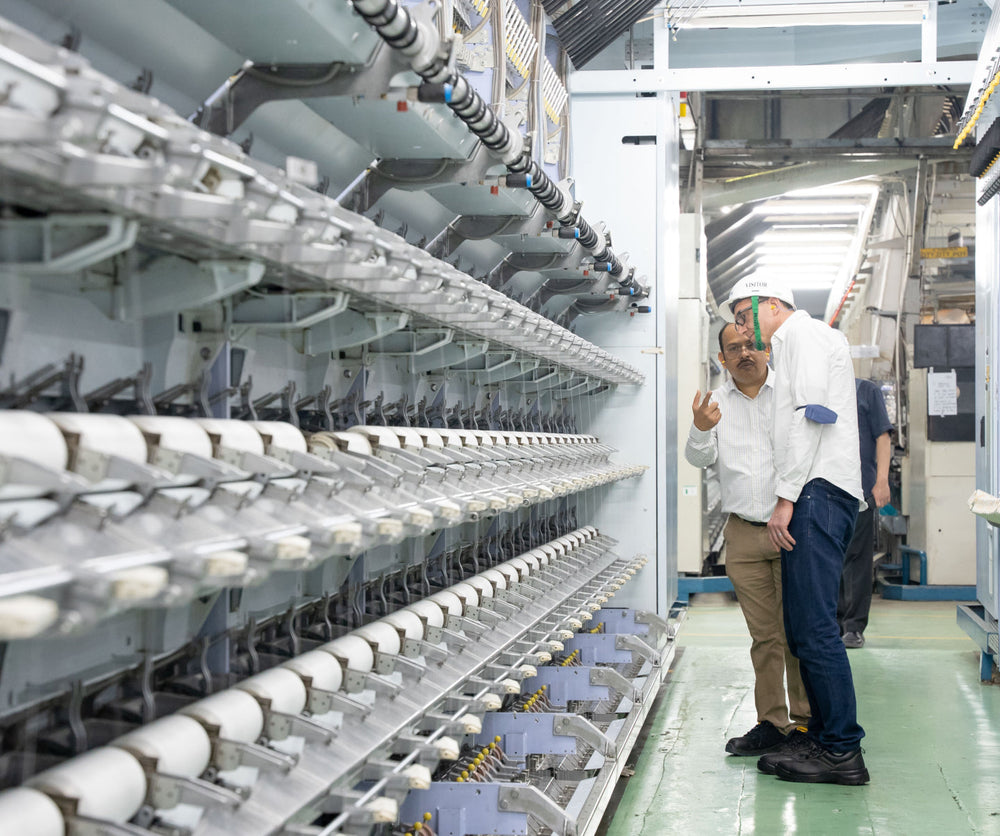
At GOT BAG, we work together with our partners to achieve a positive impact on our oceans. Our commitment to effective environmental and social standards is essential to reaching this goal.
Our Code of Conduct outlines the shared responsibilities toward people, global societies, and the environment. All our suppliers commit to complying with our Code of Conduct.
You can view our Code of Conduct here:
Amfori BSCI (Business Social Compliance Initiative) is a comprehensive program designed to identify, assess, and mitigate social risks within supply chains.
Amfori BSCI enables us to fulfill ESG due diligence obligations, increase transparency, and address material violations of working conditions in accordance with international labor law standards.


